为使宗徒之船不偏离千年航道,他毅然于1988年祝圣了传承正统的继承人
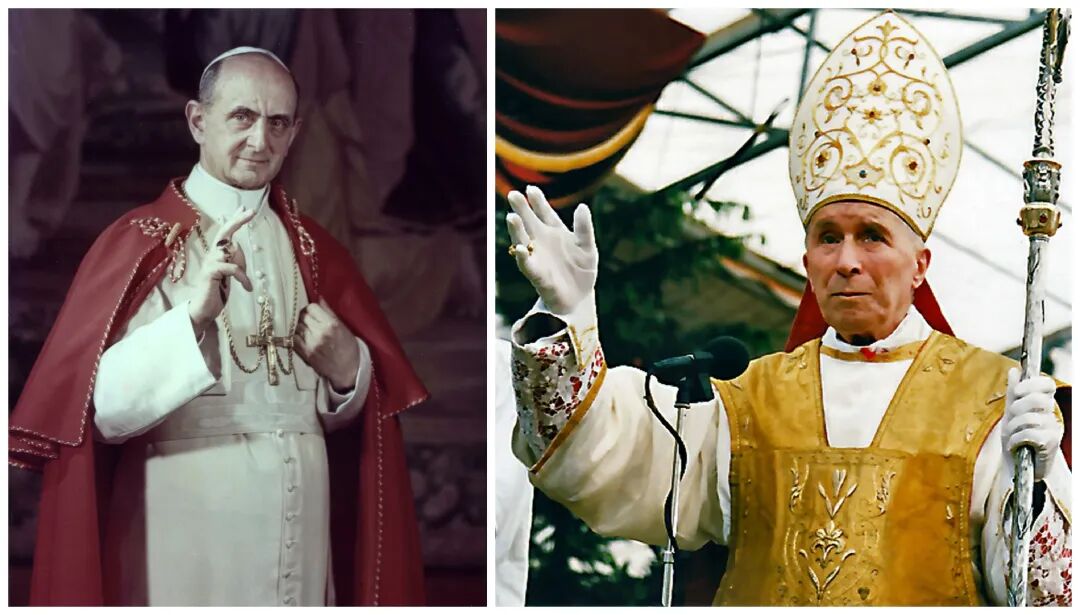
1976年9月11日,教宗保禄六世与马塞尔·勒费弗尔总主教在冈道尔夫堡进行了改变教会历史的会面。这是梵二会议后,教会内部“传统”与“革新”两股力量最直接、最激烈的碰撞。三十多分钟的对话中,有痛心的指责、有良心的辩护、有权威的训导,也有无法弥合的鸿沟。
一方是深感忧苦的伯多禄继承人,竭力维护梵二会议与合一:“我不能允许你犯下分裂教会的罪行。”另一方则是自认忠于“永恒罗马”的总主教,坚信梵二会议的某些革新,在神学与实践上已背离教会传承的“神圣传统”。面对教宗的规劝与警告,他最终以司铎的良心为依归:“我不能违背自己的良心。”
这场对话未能阻止十年后的公开决裂,但它如同一把钥匙,为我们打开了理解梵二后天主教内部的门扉——当“听天主的命胜过听人的命”(宗5:29)遇上“你是伯多禄(磐石),我要在这磐石上建立我的教会”(玛16:18);当“宽大之门”(玛7:13)与“窄路”(玛7:14)之间抉择;当“靠着那住在我们内的圣神,保守那美好的寄托”(弟后1:14)这一嘱托,与革新迎面相逢——其间的碰障不仅是制度的,更是灵魂的。勒费弗尔所坚持的,正是那“美好的寄托”在传统礼仪、教义表述的有形保存;而保禄六世所推动的,是在世海变迁中弃绝传统,与时俱进。梵二会议后,信德从理智行为转向人生态度,望德的目标从超世转向现世,爱德亦更聚焦于人。礼仪层面同样经历根本转变——拉丁语弥撒被地方语言取代,格里高利圣咏被世俗的歌曲替代,祭服、圣器、教堂空间乃至共祭方式皆发生显著变化。这种变革的统一性与深度,引发了一个根本性疑问:这究竟是圣传在历史中的更新,还是一种“本质性突变”?我们经历的是信仰在时代中的传承,还是一种新宗教的诞生?
当“保守那美好的寄托”(弟后1:14)。这场对话所触及的,正是何为对天主与教会真正忠诚的回答。
下文为根据梵蒂冈官方记录首次完整译出的会谈全文,辅以关键背景注解,呈现这决定性的半小时。
—— 保禄六世开口说道:「我真希望站在我面前的是一位弟兄、一个儿子、一位朋友。但不幸的是,阁下现在的立场,却像是一位对立教宗。」
—— 保禄六世接着说:「我还能说什么呢?阁下的言语、行动和举止,都失了分寸。您没有拒绝来见我,我也很乐意解决这件棘手的事。我会聆听,也请您反思。我自知是个贫乏的人,但此刻事关重大,关乎的不是我个人,而是教宗。而您竟判定教宗,这位信仰的最高守护者,背弃了信仰。这恐怕是史上头一遭。您向全世界宣称,教宗没有信德,他不信,他是个‘现代主义者’,等等。是的,我该谦卑。但阁下的处境已糟糕透顶。您在世人面前所做的,是极端严重的事……」
—— 勒费弗尔为自己辩护说,他无意攻击教宗本人,并承认:「或许我的某些言论和文字,确有不当之处。」
—— 但勒费弗尔补充道,他并非独自一人,而是「有一些主教、司铎和众多信友支持我。」
—— 勒费弗尔继续说道:「梵二后的教会状况,让我们无所适从。面对所有这些改变,我们要么冒失信的风险,要么给人不服从的印象。我多想跪下接受一切,但我不能违背良心。不是我发动了什么运动,是信友们不接受现状。我不是传统主义者的领袖……我的所作所为,与梵二之前完全一样。我不明白,为何我突然因按照信德、并在信德中培育司铎而受到谴责。」
—— 保禄六世打断他,否认道:「并非如此。已多次有人告知您、写信给您,指出您的错误及其缘由。您却从来不听。请继续说吧。」
—— 勒费弗尔接着说:「 许多神父和信友都觉得,梵二后在礼仪、宗教自由、圣职培育、教会与公教国家的关系,以及教会与新教关系等方面出现的种种趋向,实在难以接受。这些主张究竟如何符合教会的圣传?我们看不出来。我再说一次:这么想的不只我一个人,还有很多人。他们抓着我,推着我往前走,常常是违背我的意愿,不让我离开他们……就说里尔那次示威游行吧,那根本就不是我组织的……”……」
—— 教宗蒙蒂尼(保禄六世)打断道:「您这说的是什么话?」
——勒费弗尔恳切的解释道:「并非我主动……是电视台的安排。」
—— 保禄六世的回应,显得对情况了然于胸:「但电视播的是您说的话。是您,以极其严厉的方式,批评了教宗。」
—— 勒费弗尔随后说明情况,并指出媒体在事件中的角色:「您知道,往往是记者逼人开口……我有权为自己辩护。在罗马审判我的那些枢机诽谤了我,我相信我有权说那是诽谤……我真不知该怎么办了。我尽力按信德、并在信德中培育司铎。看到其他修院的情况,我痛苦万分:那种乱象,难以想象。还有,那些穿会衣的修道人被主教们谴责或轻视;而受赞赏的,反而是那些过着世俗化生活、行为举止和世人无异的修生。」
—— 教宗蒙蒂尼(保禄六世)回应道:「但我们也绝不赞同这些行为。我们每日都在竭力不懈地工作,为消除某些不符合教会现行法律——即大公会议与圣传的法律——的弊端。如果阁下曾努力去观察、理解我每日的所言所行,去确保教会忠于昨日,又能回应今日与明日的需要,您就不会陷入今天这般痛苦的境地。我们是最先对此类过分行为表示痛心、最急切寻求补救之道的人。但这补救之道,绝非挑战教会的权威。我已多次写信给您。您却置若罔闻。」
—— 勒费弗尔回应说,他想谈谈宗教自由,因为「我们在梵二文献中读到的,与您前任教宗们所教导的相悖。」
—— 教宗说:「这些不是在谒见时该讨论的话题。」
—— 但教宗肯定地说:「不过,我记下您的困惑了:这是您对梵二会议的态度……」
—— 勒费弗尔打断道:「我并非反对梵二,我只是反对其中的某些文献。」
—— 保禄六世接着说:「如果您不反对梵二会议,就必须服从它,服从其所有文献。」
—— 这位法国总主教(勒费弗尔)随后说:「我们必须在梵二会议的教导与您前任的教宗的教导之间做出选择。」
—— 接着,勒费弗尔请求教宗:「可否规定主教们在堂区内拨出一间小堂,让信友能像梵二之前那样祈祷?如今事事都可通融,为何不能也通融我们一下呢?」
—— 保禄六世答道:「我们是一个共融的团体。我们不能允许各部分各行其是。」
—— 勒费弗尔继续说:「梵二允许多元化。我们请求这原则也适用于我们。若教宗陛下能这样做,一切问题便迎刃而解。圣召会增加。有志圣职者渴望得到真正虔敬的培育。教宗陛下手中就握有解决问题的钥匙……」
—— 这位法国传统派总主教(勒费弗尔)随后表示,他愿意让修会部派人「监管我的修院」,并说他准备不再做讲座,留在修院里「再也不出门……」。
—— 保禄六世提醒勒费弗尔:「锡永的主教亚当(内斯托尔·亚当)曾代表瑞士主教团来见我,说他再也无法容忍您的活动……我该怎么办?请努力恢复秩序。您在世人面前与我们对立,指责我们不忠、有意摧毁教会,又怎能自认与我们共融呢?」
—— 勒费弗尔辩解道:「我从未有过此意……」
—— 但蒙蒂尼教宗(保禄六世)回答:「您亲口说过,也亲笔写过:‘我将是个现代主义教宗。落实一次梵二会议,我便是背弃教会。’您明白,若果真如此,我就必须辞职,并邀请您接替我的位置,领导教会。」
—— 勒费弗尔则说:「教会的危机确实存在。」
—— 保禄六世说:「我们为此深感痛苦。而您以您严重的抗命和对教宗的公开挑战,使这危机雪上加霜。」
—— 勒费弗尔回答:「我未得到应得的审判。」
( 译者注:“应得的审判指符合《天主教法典》规定的诉讼保障:被告知指控内容;获得辩护机会;由公正法庭审理。勒费弗尔主教暗示此前教廷对他的调查(如1975年圣座委员会聆讯)未完全遵循这些程序。)
—— 蒙蒂尼(保禄六世)回应:「《天主教法典》自会审判您。您可意识到自己给教会造成的丑闻与伤害?您意识到了吗?您能心安理得地这样去见天主吗?请您审视局面,省察良心,然后在天主面前自问:我当如何行?」
—— 这位总主教(勒费弗尔)提议:「依我看,只要稍稍放宽一点,容许我们今天还能做过去常做的事,一切都会好转。这将是立时见效的解决办法。正如我所说,我不是什么运动的领袖。我已准备好永远留在我的修院里。人们接触我的司铎,都得到神益。他们是有教会意识的青年:在街上、地铁里、任何地方都受人尊敬。别的司铎不再穿长袍、不再听告解、不再祈祷。而信众已经做出了选择:他们想要的,正是这样的司铎。」
—— 此时,勒费弗尔问教宗是否知道:「法国至少在使用十四种不同的感恩经?」
—— 保禄六世回答:「岂止十四种,怕有上百种……弊端确实存在;但梵二带来的益处是巨大的。我不想为一切辩解;正如我说,我正努力在必要时加以纠正。但同时,也应承认,多亏梵二,我们看到了青年人中强劲的灵性复苏,以及信友、司铎和主教们日益增强的责任感。」
—— 总主教(勒费弗尔)回答:「我并非说一切都坏。我愿意为教会的建设贡献力量。」
—— 蒙蒂尼教宗(保禄六世)回应道:「但这绝不是您为教会建设做贡献的方式。您可清楚自己在做什么?您可清楚您是在直接反对教会、教宗和梵二?您怎能僭越职权,去评判一次梵二会议?毕竟,这次梵二会议的文件,大部分您自己也签署了。让我们在祈祷和反思中,将一切置于基督和他的教会之下。我也会反思。我谦卑地接受您的责备。我已行至人生暮年。您的严词对我是个反思的机会。您也可以咨询我的部门,例如主教部等。我相信您也会反思。您知道我一直敬重您,认可您的功绩,我们在梵二会议上对许多问题都看法一致……」
—— 勒费弗尔承认道:「确实如此。」
(译者注:他的转变不是反复,当他目睹祭坛被简化、拉丁文的祷声渐逝,他想起经上的话:“你们要坚守我所传授给你们的。”(格前11:2)于是他选择成为一道堤坝,纵使被潮流冲击,仍紧紧抱住磐石的裂缝。他曾误判时代的记号,却从未离开天主教的圣传;他最终走向了撕裂的边界,但裂痕中依然映出他对天主教圣传的炽热(耶6:16)
—— 保禄六世总结道:「您应明白,我不能允许您犯下分裂教会的罪行,即便出于我所谓的‘个人原因’。请您发表一份公开声明,收回您近来的言论和行为——这些已被众人知晓,其目的并非建立教会,而是分裂并伤害教会。自从您与三位罗马枢机会面,裂痕就已产生。我们必须在祈祷和反思中,重获合一。」
—— 负责记录的圣座副国务卿贝内利在谈话记录文末写道:「随后,圣父邀请勒费弗尔总主教与他一同诵念了《天主经》、《圣母经》和《伏求圣神降临》。
—— 众所周知,教宗蒙蒂尼(保禄六世)的希望与祈祷终成泡影。勒费弗尔的分裂发生在此次会晤十余年后,时值若望保禄二世教宗在位。在主所喜悦的时刻,这位一生持守圣传的牧者,在耄耋之年以非凡的勇气完成了他最后的忠贞行动——为使宗徒之船不偏离千年航道,他毅然于1988年祝圣了传承正统的继承人,在历史长河中刻下了一道忠于信仰本源的印记。
—— 保禄六世的第二秘书若望·马吉蒙席在一份证词中回忆:蒙蒂尼在那次接见后,「仍希望勒费弗尔总主教能改变他攻击梵二教会的训导,但一切终归徒劳。从那时起,保禄六世便开始守斋。我清楚记得,他不愿吃肉;想减少食量,尽管他当时已吃得极少。他说,他仍需做补赎,好能以教会的名义,向上主献上对正在发生的一切的正当补偿。」
附英语全文:
Paul VI began: "I hope to have before me a brother, a son, a friend. Unfortunately, the position you have taken is that of an antipope."
Paul VI continued: "What should I say? You have allowed no measure in your words, in your actions, in your behavior. You have not refused to come to me. And I would be happy to be able to resolve such a painful case. I will listen; and I will invite you to reflect. I know I am a poor man. But here it is not the person that is at stake: it is the Pope. And you have judged the Pope as unfaithful to the Faith of which he is the supreme guarantor. Perhaps this is the first time in history that this has happened. You have told the whole world that the Pope does not have the faith, that he does not believe, that he is a modernist, and so on. I must, yes, be humble. But you find yourself in a terrible position. You perform acts, in front of the world, of extreme gravity…"
Lefebvre defended himself, saying he did not intend to attack the person of the Pope, and admitted: "Perhaps there has been something inappropriate in my words, in my writings."
But Lefebvre added that he was not alone, but: "there are bishops, priests, numerous faithful with me."
Lefebvre continued: "the situation in the Church after the Council is such that we no longer know what to do. With all these changes, either we risk losing the faith or we give the impression of disobeying. I would like to get on my knees and accept everything; but I cannot go against my conscience. It is not I who created a movement. (it is the faithful) who do not accept this situation. I am not the leader of the traditionalists… I behave exactly as I did before the Council. I cannot understand how all of a sudden I am condemned because I form priests according to the faith and in the faith."
Paul VI interrupted to deny this: "It is not true. You have been told and written to many times that you were wrong and why you were wrong. You have never wanted to listen. Continue your presentation."
Lefebvre went on: "Many priests and many faithful think that it is difficult to accept the tendencies that have emerged day after day (sic! So it appears in the transcript, ed.) the Second Vatican Council, concerning the liturgy, religious freedom, the formation of priests, the relations of the Church with Catholic States, the relations of the Church with Protestants. It is not seen how what is asserted conforms to the sound Tradition of the Church. And, I repeat, I am not alone in thinking this. There are many people who think this way. People who cling to me and push me, often against my will, not to leave them… In Lille, for example, it was not I who wanted to organize that demonstration…"
Pope Montini (Paul VI) interrupted: "But what are you saying?"
Lefebvre stammered in defense: "It wasn't me… it was television,"
Paul VI replied, seeming well informed of the situation: "But television broadcast what you said. It is you who spoke, and in an extremely harsh manner, against the Pope."
Lefebvre retorted, shifting responsibility to journalists: "You know, often it is journalists who force people to speak… And I have the right to defend myself. The Cardinals who judged me in Rome slandered me: and I believe I have the right to say that these are slanders… I no longer know what to do. I try to form priests according to the faith and in the faith. When I look at the other Seminaries, I suffer terribly: unimaginable situations. And then: religious who wear the habit are condemned or despised by Bishops: those instead who are appreciated are those who live a secularized life, who behave like people of the world."
Pope Montini (Paul VI) replied: "But We do not approve at all of these behaviors. Every day We strive with great effort and with equal tenacity to eliminate certain abuses, not conforming to the current law of the Church, which is that of the Council and of Tradition. If you had made the effort to see, to understand what I do and say every day, to ensure for the Church fidelity to yesterday and responsiveness to today and yes tomorrow, you would not have reached the painful point in which you find yourself. We are the first to deplore the excesses. We are the first and the most solicitous to seek a remedy. But this remedy cannot be found in a challenge to the authority of the Church. I have written to you repeatedly. You have not taken my words into account."
Lefebvre replied that he wanted to speak of religious liberty, because: "what one reads in the conciliar document is contrary to what your Predecessors have said."
The Pope said: "these are not topics to discuss in the course of an audience."
But the Pope affirmed: "but I take note of your perplexity: it is your attitude against the Council…"
Lefebvre interrupted: "I am not against the Council. but I am against some of its texts."
Paul VI continued: "If you are not against the Council. you must adhere to it, to all its documents."
The Archbishop from France (Lefebvre) then said: "It is necessary to choose between what the Council has said and what your Predecessors have said."
Lefebvre then asked the Pope: "Wouldn't it be possible to prescribe that Bishops grant, in churches, a chapel where people can pray as before the Council? Today everything is permitted to everyone: why not permit something to us as well?"
Paul VI responded: "We are a community. We cannot permit autonomies of behavior to the various parts."
Lefebvre continued: "The Council admits pluralism. We ask that this principle be applied also to us. If Your Holiness would do so, everything would be resolved. There would be an increase in vocations. Aspirants to the priesthood want to be formed in true piety. Your Holiness has in your hands the solution to the problem…"
The traditionalist Archbishop from France (Lefebvre) then stated he was willing: for someone from the Congregation for Religious to "keep watch over my Seminary", and said he was ready to no longer give conferences and to remain in his Seminary "without ever leaving it again…".
Paul VI reminded Lefebvre: "Bishop Adam (Nestor Adam, Bishop of Sion, ed.) came to speak to me on behalf of the Swiss Episcopal Conference, to tell me that he could no longer tolerate your activity… What should I do? Strive to return to order. How can you consider yourself in communion with Us, when you take a position against Us, in front of the world, to accuse Us of infidelity, of a will to destroy the Church?"
Lefebvre pleaded: "I never had that intention…"
But Pope Montini (Paul VI) answered: "You have said it and you have written it. I would be a modernist Pope. By applying an Ecumenical Council, I would betray the Church. You understand that, if it were so, I would have to resign; and invite you to take my place to lead the Church."
Lefebvre then said: "The crisis in the Church exists."
Paul VI said: "We suffer deeply from it. You have contributed to aggravating it, with your solemn disobedience, with your open challenge against the Pope."
Lefebvre replied: "I am not judged as I should be."
Montini (Paul VI) responded: "Canon Law judges you. Have you noticed the scandal and the harm you have done to the Church? Are you conscious of it? Would you feel like going, thus, before God? Make a diagnosis of the situation, an examination of conscience and then ask yourself, before God: what should I do?"
The Archbishop (Lefebvre) proposed: "It seems to me that by opening a bit the range of possibilities of doing today what was done in the past, everything would be fixed. This would be the immediate solution. As I said, I am not the head of a movement. I am ready to remain shut up forever in my Seminary. People make contact with my priests and remain edified. They are young people who have the sense of the Church: they are respected in the street, in the metro, everywhere. The other priests no longer wear the cassock, no longer hear confessions, no longer pray. And the people have chosen: here are the priests we want."
At this point, Lefebvre asked the Pope if he knew: "of at least fourteen Eucharistic Prayers that are used in France?"
Paul VI answered: "Not only fourteen, but a hundred… There are abuses; but the good brought by the Council is great. I do not want to justify everything; as I said I am seeking to correct where it is necessary. But it is right, at the same time, to recognize that there are signs, thanks to the Council, of vigorous spiritual recovery among the young, an increase in the sense of responsibility among the faithful, priests, bishops."
The Archbishop (Lefebvre) replied: "I do not say that everything is negative. I would like to collaborate in the building up of the Church."
Pope Montini (Paul VI) responded: "But it is certainly not in this way that you contribute to the building up of the Church. But are you conscious of what you are doing? Are you conscious that you are going directly against the Church, the Pope, the Ecumenical Council? How can you arrogate to yourself the right to judge a Council? A Council, after all, whose acts, in large part, were also signed by you. Let us pray and reflect, subordinating everything to Christ and to his Church. I too will reflect. I accept with humility your reproaches. I am at the end of my life. Your severity is for me an occasion for reflection. You will also consult my offices, such as e.g. the S.C. for Bishops, etc. I am sure that you too will reflect. You know that I have had esteem for you, that I have recognized your merits, that we found ourselves in agreement, at the Council, on many problems…"
Lefebvre acknowledged: "It's true."
Paul VI concluded: "You will understand, that I cannot permit, even for reasons that I would call 'personal', that you render yourself guilty of a schism. Make a public declaration, by which your recent declarations and your recent behaviors are retracted, of which everyone has taken note as acts placed not to build up the Church, but to divide it and do it harm. Ever since you met with the three Roman Cardinals, there has been a rupture. We must rediscover union in prayer and reflection."
The Substitute Benelli wrote at the end of the transcript: "The Holy Father then invited Archbishop Lefebvre to recite with Him the 'Our Father', the 'Hail Mary', the 'Come Holy Spirit'."
As is known, Pope Montini's (Paul VI) hopes and prayers came to nothing. The Lefebvrist schism occurred more than a decade after this meeting, during the pontificate of John Paul II. Then, Lefebvre, now elderly, decided to ordain new bishops without papal mandate.
Paul VI's second secretary, Monsignor John Magee, recalled in a testimony: Montini, after that audience, "hoped that the archbishop (Lefebvre, ed.) had decided to change his way of conducting attacks on the Church and the teaching of the Council, but it was all useless. From that moment Paul VI began to fast. I remember well that he did not want to eat meat; he wanted to reduce the quantity of food he took even though he already ate very little. He said that he still had to do penance, so as to offer to the Lord, in the name of the Church, the just reparation for all that was happening."